


Key takeaways
As of 2026, approximately 27% of full-time employees worldwide work remotely, while an additional 52% engage in hybrid roles. Here’s what you need to know:
- Where to find talent: Job boards, LinkedIn, tech communities, and specialized recruitment agencies.
- How to screen effectively: Skills testing, cultural fit assessment, video interviews.
- What candidates expect: Clear communication, defined processes, and competitive remote-friendly packages.
- Timeline: Plan 4–6 weeks from posting to extend an offer to quality hires.
Why hire remote employees in 2026?
Remote hiring gives you access to global talent. You can hire a remote employee from Poland, Romania, Portugal, or anywhere in Europe without opening a local office.
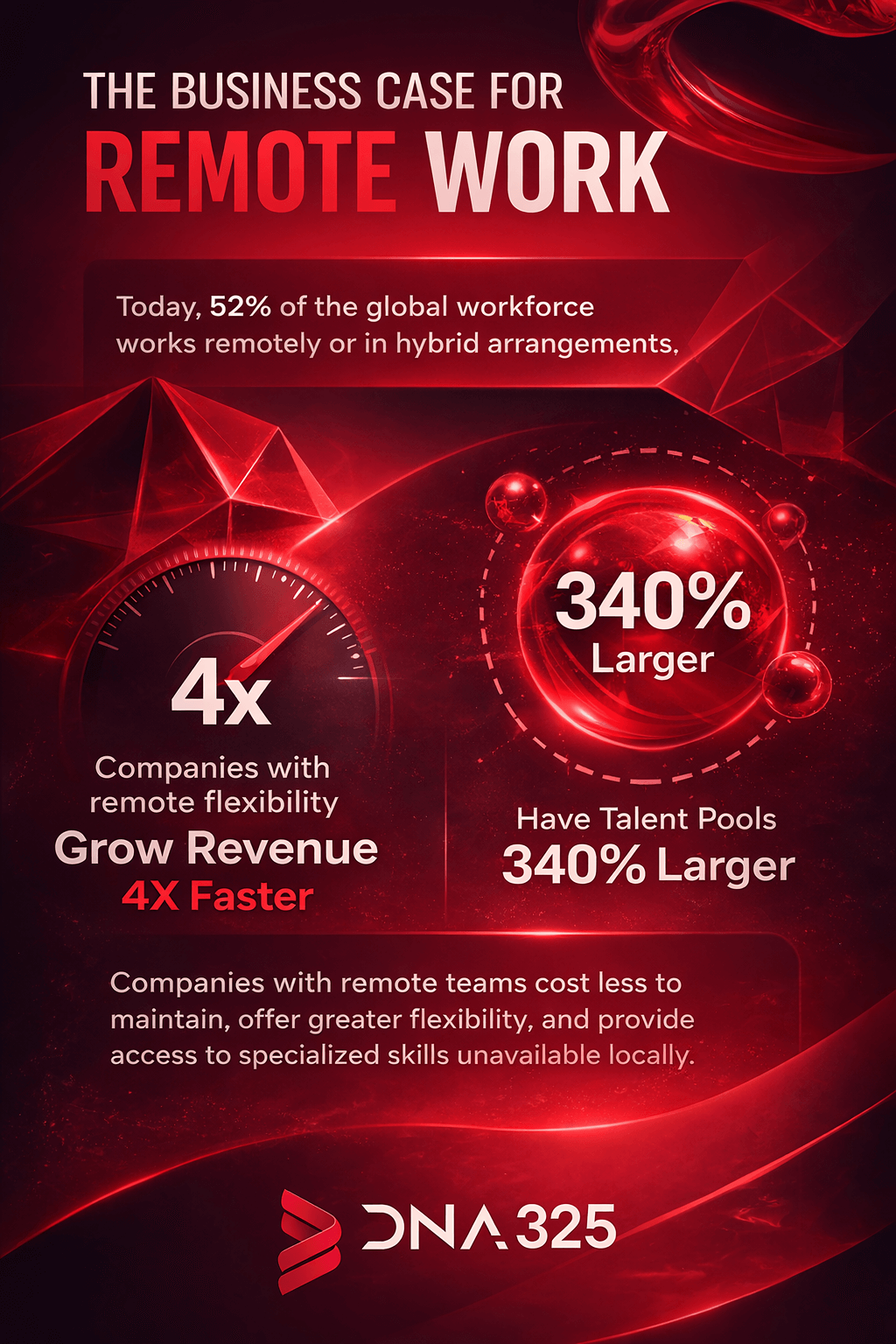
The business case is clear. Companies with remote flexibility grow revenue 4x faster and have talent pools 340% larger. Remote teams cost less to maintain, offer greater flexibility, and provide access to specialized skills that are unavailable locally.
Brief context: Today, 52% of the global workforce works remotely or in hybrid arrangements.
What this means for hiring: Remote work is the default, not the exception. Candidates expect it. Companies offering it win the talent.
Reasons to hire a remote employee
Hiring remote employees delivers measurable advantages:
- Access to specialized talent.
- Reduced overhead costs.
- Higher productivity.
- Improved retention.
- Faster scaling.
Access to specialized talent
You can hire a remote employee with niche skills (Rust developers, AI engineers, cybersecurity specialists) regardless of location. European countries such as Poland, Romania, and the Czech Republic produce thousands of qualified tech graduates annually who prefer remote work arrangements.
Reduced overhead costs
Real estate savings average $10,000 per employee annually when you hire remote employees. You eliminate office space, utilities, equipment, and commute subsidies.
Higher productivity
Remote employees tend to be as productive or more productive than office-based colleagues. They experience fewer workplace distractions and can structure their workday around peak productivity hours.
Improved retention
Many workers say they would not accept roles that require full-time office attendance, and some cite flexibility as a primary reason for staying in their current job. When you hire remote employees and maintain flexibility, you keep them longer.
Faster scaling
Need to ramp up for a project? Hiring a remote employee lets you expand quickly without physical infrastructure constraints. Partnering with specialized IT recruiting agencies in your target region can cut hiring timelines from months to weeks. They use pre-vetted talent pools and select candidates who match your business needs.
Challenges when you hire remote employee
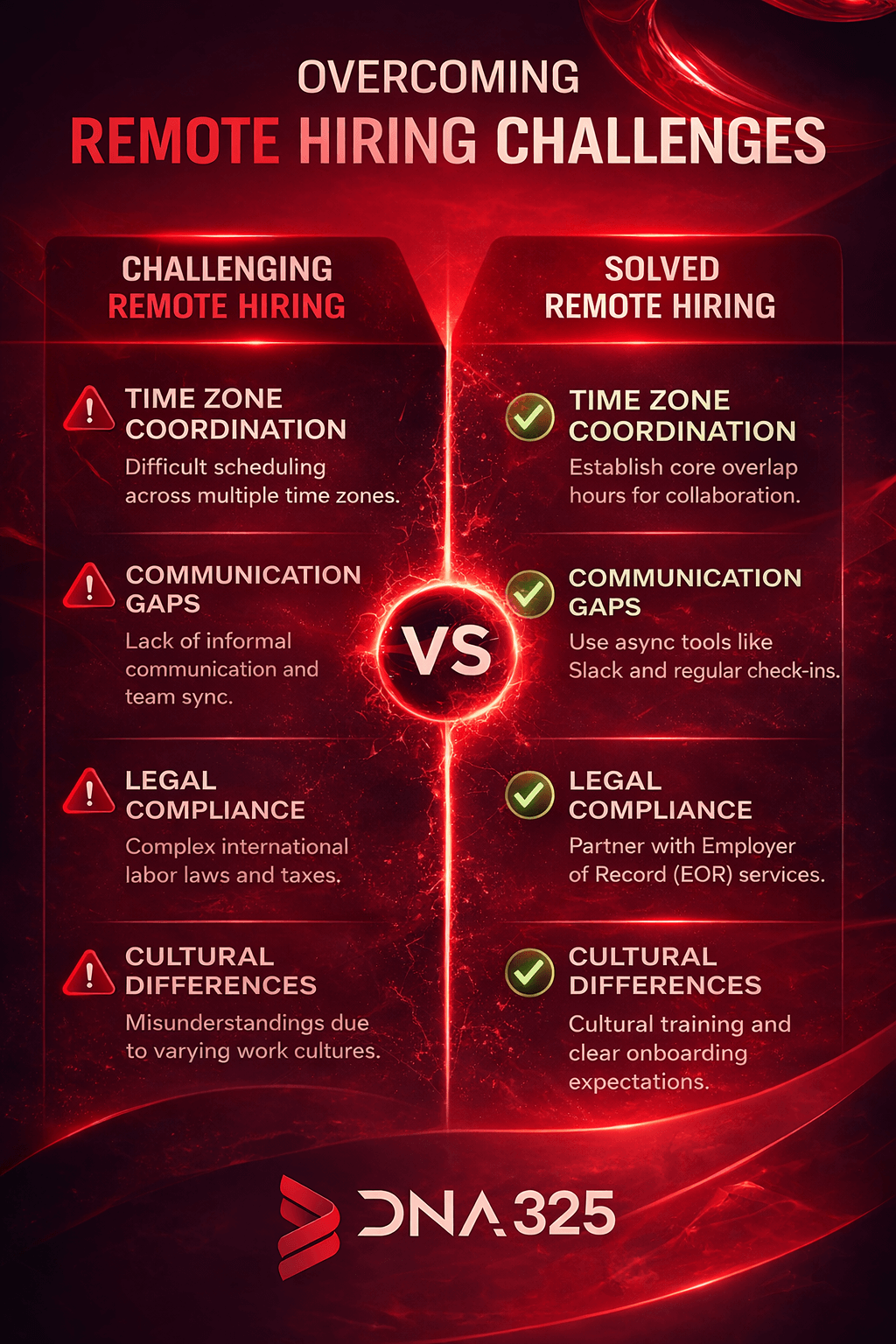
Remote hiring introduces specific obstacles: time zone coordination, communication gaps, legal compliance, and cultural differences.
Time zone coordination
Hiring remote employees across multiple time zones requires careful scheduling. A developer in Eastern Europe operates 6–9 hours ahead of US East Coast time.
Solution: Establish core overlap hours. Many companies require 3–4 hours of daily overlap for team collaboration.
Communication gaps
Remote employees miss informal office conversations and spontaneous problem-solving.
Solution: Use async communication tools like Slack, establish check-in cadences, and create documentation habits.
Legal compliance
Each country has distinct labor laws, tax requirements, and employment regulations when you hire a remote employee internationally.
Solution: Partner with Employer of Record (EOR) services or work with agencies specializing in European employment law.
Cultural differences
Eastern, Western, and Southern European work cultures differ in communication styles, decision-making, and teamwork approaches. For example, a remote employee from Poland may interact differently from one from Spain.
Solution: Invest time in cultural training and establish clear expectations during onboarding.
How to hire remote employees step by step
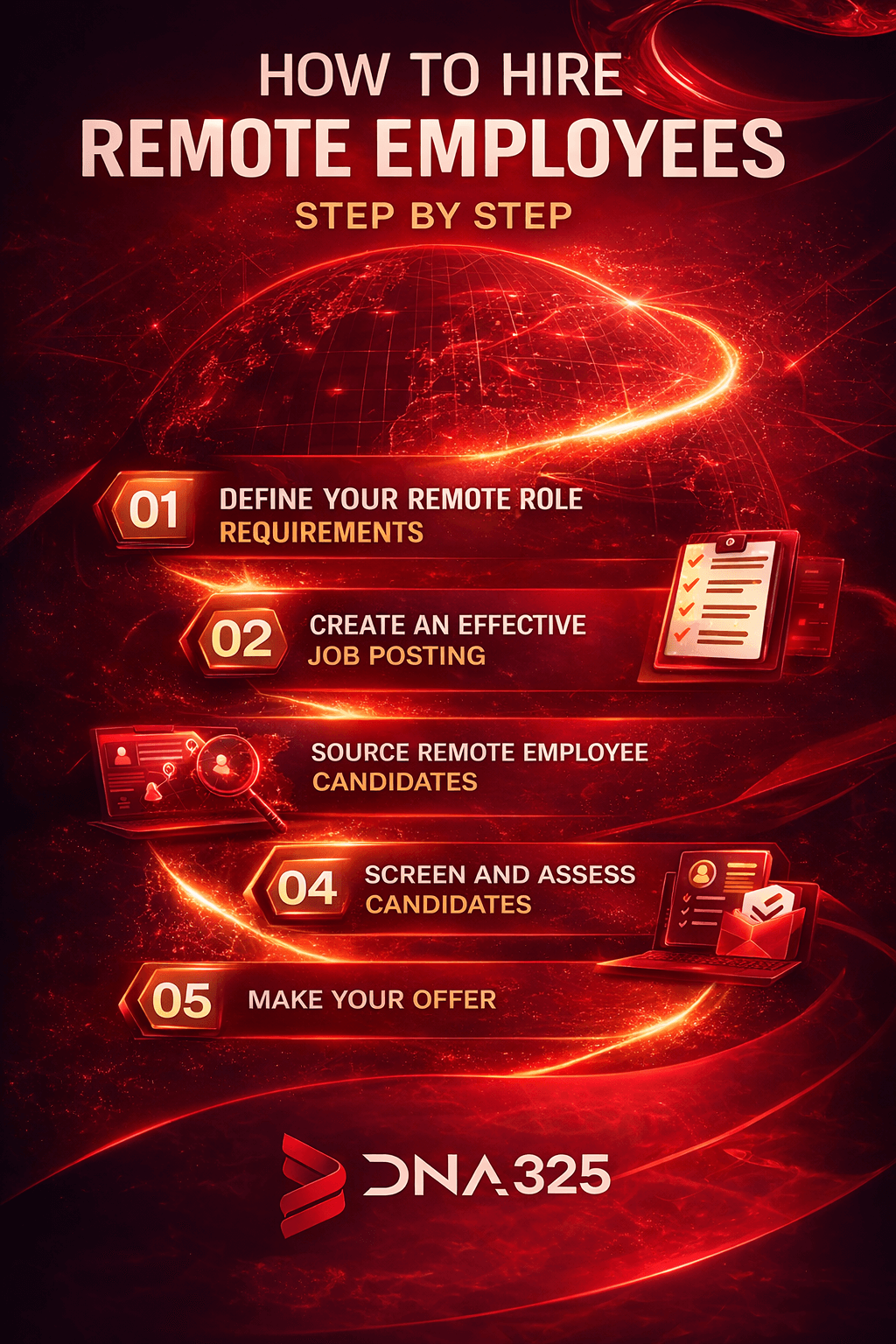
- Define your remote role requirements.
- Create an effective job posting.
- Source remote employee candidates.
- Screen and assess candidates.
- Make your offer.
1. Define your remote role requirements
Start with a clear picture. Not every job is remote-friendly. Identify which roles thrive without physical presence.
Write this down:
- Required technical skills (specific languages, frameworks, tools).
- Necessary soft skills (self-management, communication, problem-solving).
- Experience level (junior, mid-level, senior).
- Time zone requirements (core hours, flexibility level).
- Remote work experience (preferred but not required).
For IT roles that hire remote employees: Backend developers, frontend engineers, DevOps specialists, data scientists, and QA engineers typically excel remotely. Roles requiring extensive hardware access or access to sensitive on-premises systems may not.
2. Create an effective job posting
Your job post determines candidate quality. You must convince someone to enter a relationship with you. Make it compelling.
Include these elements:
- Clear, specific title: “Senior React Developer (Remote – Europe)” beats “Developer Wanted.”
- Immediate role clarity: “We need a React developer to rebuild our customer dashboard,” tells candidates exactly what they’ll do.
- Remote work specifics:
- Fully remote or hybrid expectations.
- Required time zone overlap.
- Equipment provision (laptop, monitor, etc.).
- Communication tools used.
- Responsibilities and deliverables: Focus on outcomes, not presence. “Ship two major features per quarter,” not “be available 9–5.”
- Required qualifications: Be specific about must-haves. “5+ years React, 3+ years TypeScript, experience with Redux” sets clear expectations.
- Your company story: Share your mission, team culture, and what makes your company unique. Remote candidates care deeply about company values.
3. Source remote employee candidates
Where to find remote employees in 2026:
- Specialized job boards: Stack Overflow Jobs, We Work Remotely, and AngelList focus on remote tech roles. European boards like JustJoin.it (Poland) target regional talent.
- LinkedIn: Post to your company page and use LinkedIn Recruiter to search by skills and location. Target European tech hubs: Warsaw, Kraków, Bucharest, Prague, Lisbon, Barcelona.
- Tech communities: GitHub, Dev.to, Hacker News, and Reddit r/forhire connect you with active developers. European Discord servers and Slack communities provide direct access.
- Employee referrals: Referrals reduce time-to-hire and save on advertising costs. Your current remote employees know others in their networks.
- Recruitment agencies: Specialized agencies maintain databases of pre-vetted European tech talent and handle compliance, screening, and cultural fit assessment.
4. Screen and assess candidates
Efficient screening saves time:
- Resume review: Look for remote work experience, relevant technical skills, and evidence of self-management. Gaps in employment matter less for remote employees than demonstrated ability to deliver independently.
- Pre-screening assessment: Pre-employment skills testing narrows the candidate pool by identifying relevant skills early. Send short technical tests (30–60 minutes) before interviews.
- Video screening call: Virtual interviews are just as effective as in-person. Use this 30-minute call to assess communication skills, verify basic qualifications, and gauge interest.
- Technical interview: Deep dive into problem-solving ability. Ask candidates to explain past projects, walk through architectural decisions, or solve a real problem your team faces.
- Behavioral assessment: Remote employees need self-motivation and communication skills. Ask:
- “Describe your ideal remote workday structure.”
- “How do you handle unclear requirements or blocked tasks?”
- “What collaboration tools have you used effectively?”
5. Make your offer
After identifying the right candidate:
- Move quickly: Remote hiring is 16% faster on average, but top candidates receive multiple offers. Make your decision within 48 hours of the final interviews.
- Structure your offer:
- Role title and responsibilities.
- Start date and onboarding timeline.
- Remote work arrangement specifics.
- Benefits package (health insurance, equipment allowance, professional development budget).
- Communication expectations.
- Be transparent: Share your remote work policies, communication norms, and team structure. Remote employees value clarity above all else.
Onboarding remote employees successfully
Poor onboarding leads to 20% of new hires leaving within 45 days. A smooth onboarding process is essential for remote workers.
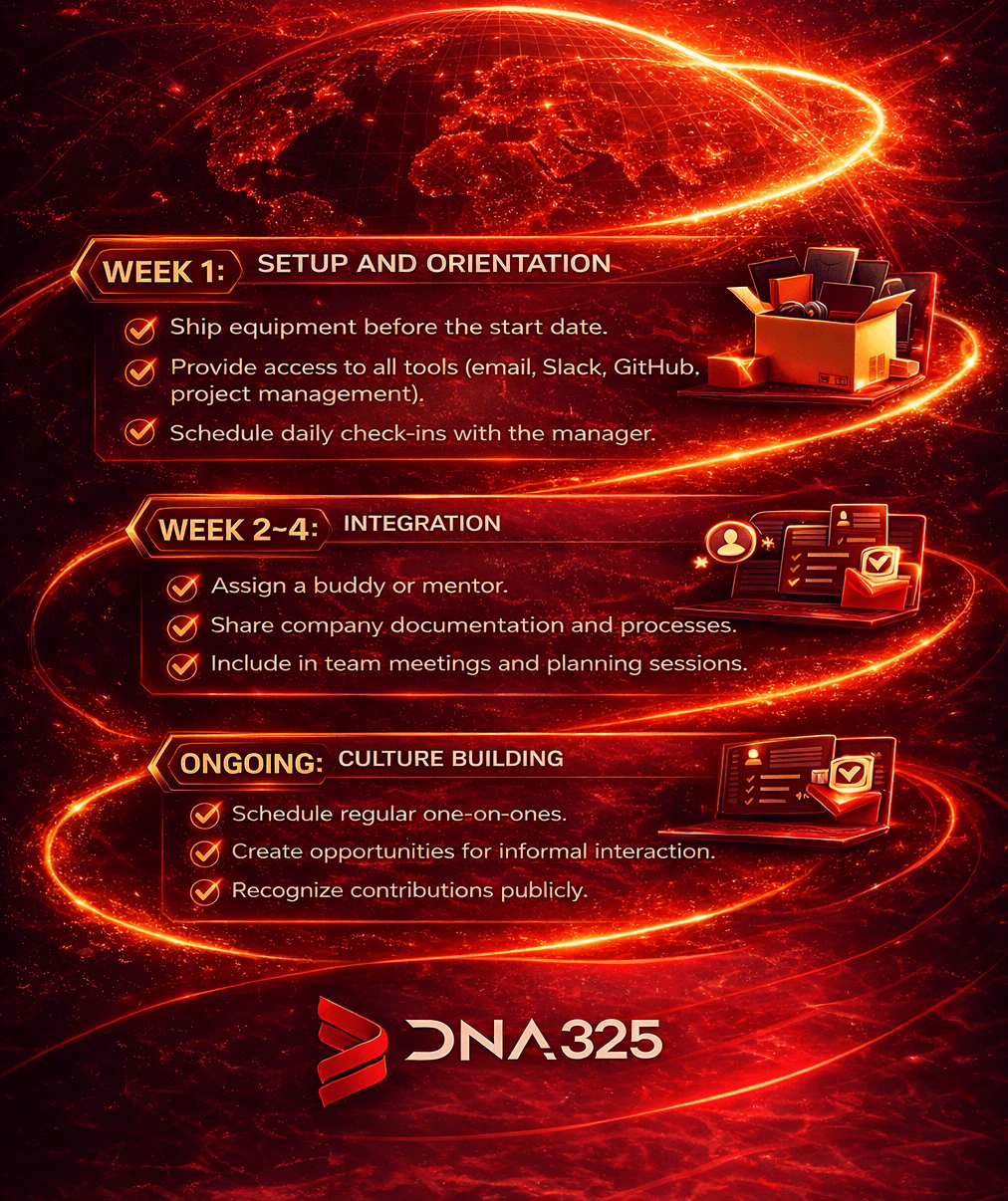
Week 1: Setup and orientation
- Ship equipment before the start date.
- Provide access to all tools (email, Slack, GitHub, project management).
- Schedule daily check-ins with the manager.
- Introduce team members individually.
Week 2–4: Integration
- Assign a buddy or mentor.
- Share company documentation and processes.
- Include in team meetings and planning sessions.
- Set clear initial goals and deliverables.
Ongoing: Culture building
- Schedule regular one-on-ones.
- Create opportunities for informal interaction.
- Recognize contributions publicly.
- Invest in professional development.
Best practices when hiring remote employee
- Focus on outcomes, not activity.
- Over-communicate initially.
- Build async-first processes.
- Invest in the right tools.
- Establish core hours.
- Create social connections.
- Provide growth opportunities. 👇
1. Focus on outcomes, not activity
Measure what remote employees deliver, not when they’re online. Set clear goals, define success metrics, and trust your team to manage their time.
2. Over-communicate initially
You can’t over-communicate with remote teams. Share context, explain decisions, and document everything. What seems obvious in an office requires explicit communication over remote channels.
3. Build async-first processes
Design workflows that don’t require everyone to be online simultaneously. Use tools like Notion, Confluence, or Linear to document decisions and progress.
4. Invest in the right tools
Video: Zoom, Google Meet.
Chat: Slack, Microsoft Teams.
Project management: Linear, Jira, Asana.
Documentation: Notion, Confluence.
Code collaboration: GitHub, GitLab.
5. Establish core hours
Require 3–4 hours of daily overlap for collaboration while allowing flexibility around those hours.
Remote employees need community. Host virtual coffee chats, team games, and annual in-person gatherings.
7. Provide growth opportunities
Retention requires investing in career growth, learning resources, and regular feedback cycles. Remote employees want development paths, not just jobs.
Remote work tools and technology stack
The right tools make or break remote teams. When you hire remote employee, your technology choices directly impact productivity, collaboration, and retention.
You need:
- Communication tools form your foundation.
- Project management determines visibility.
- Documentation preserves knowledge.
- Code collaboration enables distributed development.
- Time zone and calendar management.
- Security and access control.
- Equipment and workspace. 👇
Communication tools form your foundation
Synchronous communication: Zoom and Google Meet handle video calls. Choose one and standardize it. Remote employees switching between platforms waste time troubleshooting audio and screen-sharing issues.
Asynchronous communication: Slack dominates tech teams, Microsoft Teams serves enterprise environments. Create clear channel structures: public channels for transparency, private channels for sensitive discussions, and direct messages for quick questions.
Project management determines visibility
Task tracking: Linear works well for engineering teams with its keyboard-first design and GitHub integration. Jira suits larger organizations with complex workflows. Asana serves cross-functional teams needing flexibility.
Sprint planning: When you hire remote employees across time zones, async sprint planning becomes critical. Tools like Linear and Jira let team members review sprint goals, estimate tickets, and commit to work without real-time meetings.
Documentation preserves knowledge
Company wiki: Notion offers flexibility with databases, tables, and embedded content. Confluence integrates tightly with Atlassian tools. Choose based on your existing stack.
Technical documentation: GitHub wikis keep docs close to code. GitBook creates beautiful public documentation. Remote employees need searchable, up-to-date documentation. Choose tools that make updating easy.
Code collaboration enables distributed development
Version control: GitHub and GitLab provide code hosting, pull request reviews, and CI/CD pipelines. Remote employees rely on detailed PR descriptions and code comments since they can’t tap a colleague’s shoulder for context.
Pair programming: Tuples, VS Code Live Share, and GitHub Codespaces enable remote employees to collaborate on code in real time, regardless of distance.
Time zone and calendar management
World clock: When you hire remote employees globally, tools like World Time Buddy help schedule meetings across zones. Build this awareness into your culture. Always include time zones in meeting invites.
Async standups: Geekbot, Standuply, and custom Slack workflows replace synchronous standup meetings. Remote employees share updates on their schedules, and managers review them at their convenience.
Security and access control
Password management: 1Password or Bitwarden lets remote employees securely share credentials. No more passwords in Slack messages.
VPN and zero-trust: Remote employees need secure access to internal systems. Tailscale, Cloudflare Access, or traditional VPNs protect company resources.
Equipment and workspace
Hardware provisioning: Remote employees need consistent equipment. Partner with vendors such as Apple Business Manager or Dell to streamline laptop purchasing and shipping.
Expense management: Brex, Ramp, or traditional expense systems enable remote employees to purchase necessary equipment and supplies without bureaucratic hurdles.
Choose tools that grow with you. Start simple when you hire a remote employee or two. Add complexity as your team scales. The best tool is the one your team actually uses.
How to evaluate remote work experience in candidates
Not all remote work experience is equal. A developer who worked from home during pandemic lockdowns differs dramatically from someone who thrived in distributed teams for years.
Here’s what to do:
- Look beyond the “remote” label on resumes.
- Consider red flags and green flags.
- Ask questions to assess remote work capability.
- Test remote skills during the interview process. 👇
Look beyond the “remote” label on resumes
Duration and consistency matter. Five years of remote work signal genuine experience. Six months in 2020 means they survived the emergency transition to remote work. Ask: “How long have you worked remotely? Was it by choice or circumstance?”
Company remote maturity reveals context. Working remotely at GitLab (remote-first since founding) differs from being the only remote employee at an office-centric company. Ask: “Was your entire team remote, or were you the only remote person?”
Role complexity indicates skill level. Junior developers joining established remote teams learn from existing processes. Senior engineers who build remote workflows from scratch demonstrate greater capability. Ask: “Were you hired into an existing remote team with established processes, or did you help build remote workflows?”
Red flags when hiring remote employees
Vague communication about remote work. Strong remote employees speak specifically about their setup, tools, and processes. Candidates who answer “I just worked from home” without providing details likely lack intentional remote-work skills.
No examples of async work. Ask: “Describe a time you solved a complex problem without real-time communication.” Strong candidates describe documentation they created, thorough PR descriptions they wrote, or decisions they made with context from written discussions.
Inability to discuss remote challenges. Everyone faces remote work obstacles. Candidates who claim remote work is perfect either lack experience or self-awareness. Ask: “What was your biggest challenge working remotely, and how did you address it?”
Green flags that predict success
Specific communication habits. Strong candidates describe their communication cadence: “I send daily updates to my manager, respond to Slack within 2 hours during work hours, and document decisions in Notion before implementation.”
Proactive problem-solving examples. Ask: “Tell me about a time you were blocked and couldn’t get immediate help. What did you do?” Strong remote employees research, document their findings, unblock themselves on parallel work, and follow up persistently but respectfully.
Tool fluency. Experienced remote employees have opinions about tools. They compare Slack versus Discord, explain why they prefer Linear over Jira, or discuss documentation strategies. This fluency signals genuine experience.
Portfolio and visible work. Remote developers often have active GitHub profiles, technical blogs, or open-source contributions. These artifacts demonstrate self-motivation and public communication skills.
Questions to assess remote work capability
“Walk me through your typical remote workday.” Strong answers include specific routines, focus blocks, communication patterns, and boundary-setting.
“How do you build relationships with remote teammates?” Look for intentional strategies beyond “Zoom happy hours.” Strong answers mention regular one-on-ones, jumping on calls to help teammates, and contributing to non-work chat channels.
“Describe a project where you worked with teammates across multiple time zones.” This reveals async collaboration skills, documentation habits, and cultural awareness.
“What’s your home office setup?” This may seem superficial, but it demonstrates professionalism. Strong candidates describe ergonomic furniture, high-quality audio/video equipment, and reliable internet connectivity. Red flag: “I work from my couch” suggests a lack of investment in remote work.
Test remote skills during the interview process
Evaluate written communication. Remote work runs on writing. Does the candidate send clear, well-structured emails? Do their follow-up messages include necessary context? Poor writing kills remote productivity.
Observe video presence. Professional remote employees have high-quality audio, proper lighting, and a stable internet connection. Technical glitches happen, but consistent problems suggest they haven’t invested in their remote setup.
Assign a take-home project. Evaluate not just the code quality but the documentation, commit messages, and README. Strong remote developers write for future readers.
Bonus: When you hire remote employees without remote experience
Sometimes you find the perfect technical candidate who lacks remote experience. This works if they demonstrate traits compatible with remote work.
Look for self-directed learners. Ask about projects they tackled independently, technical skills they taught themselves, or problems they solved without guidance.
Assess written communication. Strong writers can develop remote work skills faster than weak communicators can learn to write clearly.
Set expectations explicitly. During onboarding, provide specific guidance on communication frequency, documentation standards, and collaboration norms. Strong candidates adapt quickly when expectations are clear.
Plan additional check-ins. First-time remote employees need more structure initially. Schedule daily standups for the first month, then gradually reduce frequency as they demonstrate independence.
Remote work experience correlates with success, but motivated candidates with the right traits can develop these skills quickly when you hire a remote employee and provide proper support.
Hiring remote employees in 2026: What’s different?
The market has matured. Early remote work chaos has evolved into structured, professional remote operations.
What changed:
- Candidates are selective. Just 16% of professionals prefer in-office jobs, according to Robert Half. Remote employees expect companies to be competent at distributed work.
- Tools are better. Video quality, collaboration software, and project management platforms have improved dramatically since 2020.
- Compliance is clearer. European countries have established remote work frameworks. Portugal and Spain offer digital nomad visas. EOR services simplify international hiring.
How DNA325 helps you hire remote employees
DNA325 specializes in remote IT recruitment across Europe. We connect US and EU businesses with pre-vetted developers, engineers, and technical specialists ready to work remotely.
Our process:
- Pre-screened talent pool of European IT professionals.
- Technical and cultural fit assessment.
- English proficiency verification.
- Complete recruitment management with a dedicated project manager.
- Support through offer negotiation and onboarding.
We handle the complexities of European remote hiring. You focus on building your business.
FAQ about hiring a remote employee
Plan 4–6 weeks from job posting to offer acceptance. This includes 1 week for applications, 2–3 weeks for interviews and testing, and 1 week for decision-making and offers.
For core team roles requiring long-term investment, hire full-time employees. For project-based or specialized work, contractors offer flexibility. Avoid misclassification. Understand the difference between contractors and employees under local law.
Treating remote work as temporary or bolting it onto office-centric processes. Companies that don’t adapt their workflows, communication, and management style to remote work create friction and lose talent.
No. You can use an Employer of Record (EOR) service to hire employees legally without establishing a local entity. The EOR becomes the legal employer while you maintain day-to-day management.
Address it immediately through one-on-one conversations. Remote work requires clearer feedback loops. Set specific improvement goals, increase check-in frequency, and document everything. European labor laws have specific termination procedures you must follow.
Each employee follows their country’s public holiday calendar. Build this into project planning. Don’t expect Polish employees to work on November 11 (Independence Day) or Romanian employees on December 1 (National Day).
Only if stated clearly in the employment contract. “Remote” means remote. If you need a periodic office presence, call it “remote-first” or “hybrid” and specify the requirement up front (e.g., “quarterly week-long team gatherings”).