


Key takeaways
Need Unity developers fast? Europe’s tech hubs (Ukraine, Poland, Romania, Bulgaria, the Czech Republic, etc.) offer thousands of skilled developers. They bring C# expertise, cross-platform optimization skills, AR/VR experience, strong English proficiency, and a proven track record in gaming studios. Remote hiring through specialized recruitment agencies cuts timelines from months to weeks while avoiding local compliance headaches.
Why hire Unity developers from Europe?
Short answer: Europe combines high technical skills, robust STEM education, and a mature gaming industry. This makes it the go-to destination for scalable, remote Unity teams.
Unity dominates game development in 2026. According to Apollo Technical, Unity’s ecosystem supports 1.5 million active developers per month. It powers successful titles such as Pokémon GO, Among Us, and Beat Saber. The engine’s versatility across mobile, console, PC, VR, and AR platforms means businesses need Unity specialists who can optimize performance across all targets.
Specific advantages when you hire Unity developers from Europe
Technical depth: Developers master C# programming, Unity’s Data-Oriented Tech Stack (DOTS), shader programming, multiplayer networking (Photon, Mirror), and performance optimization for low-end mobile devices.
Gaming heritage: The region is home to established studios. Ukraine hosts N-iX Games in Lviv, known for structured Unity production. Poland’s Ten Square Games delivers high-quality 2D/3D Unity projects. The Czech Republic’s Bohemia Interactive, based in Prague, pioneers simulation gaming and military shooters.
English fluency: Romanian, Polish, and Bulgarian developers are generally comfortable working in English, which helps keep daily standups, sprint planning, and code reviews efficient.
Time zones: Western European companies operate on a 1-hour time zone difference from Ukraine, Bulgaria, and Romania. No time difference with Poland, the Czech Republic, and Slovakia. US companies can establish round-the-clock development cycles.
Top European countries to source Unity developers
Short answer: Focus on Ukraine, Poland, Romania, Bulgaria, and the Czech Republic for the best combination of Unity expertise, developer availability, and remote collaboration infrastructure.
Ukraine
Main info: Ukraine offers one of the largest Eastern European tech talent pools and deep expertise in Unity gaming.
Ukraine’s capital, Kyiv, ranks among Europe’s fastest-growing tech hubs in the Dealroom Ecosystem Index. Ukrainian Unity developers work on AAA projects for international publishers.
Studios like N-iX Games specialize in Unity co-development and full-cycle production. Developers excel in Unity VR/AR, mobile optimization, and shader programming.
Poland
Main info: Poland leads Eastern Europe with a developer talent pool and the region’s most mature startup ecosystem.
Polish developers bring strong problem-solving skills, Agile/Scrum experience, and familiarity with Western business practices. Strong GDPR compliance and IP protection standards make Poland an ideal jurisdiction for regulated industries.
Romania
Main info: Romania offers a balanced mix of competitive rates and a rapidly expanding Unity development ecosystem.
Romania’s tech sector received nearly $150+ million in VC investment in recent years. Bucharest serves as a major tech hub. Romanian developers rank highly for English proficiency and cultural alignment with Western teams.
Unity developers in Romania handle 2D/3D game development, cross-platform optimization, and AR experiences. The country’s STEM education produces specialists in physics engines, animation systems, and multiplayer networking.
Bulgaria
Main info: Bulgaria provides exceptional value with strong technical capabilities and lower operational costs.
Sofia ranks among Eastern Europe’s emerging tech centers. Bulgarian developers demonstrate expertise in Unity UI (uGUI), performance optimization, and asset integration. The country’s EU membership ensures compliance with the GDPR and the use of transparent contracts.
Bulgarian Unity specialists work on mobile games, simulations, and VR training applications. They bring proficiency in C#, version control (Git), and Unity Analytics.
Czech Republic
Main info: The Czech Republic offers top-tier Unity talent, especially for simulation, automation, and VR projects.
Prague’s Bohemia Interactive and Amanita Design represent the Czech gaming industry’s quality. The country ranks highly in robotics and automation, making it an ideal destination for Unity developers working on industrial applications or digital twins.
Czech developers excel in large-scale simulations, military shooters, and artistic adventure games built with Unity. They combine technical precision with creative problem-solving.
What Unity skills should you look for?
Short answer: Prioritize C# proficiency, cross-platform optimization experience, and a portfolio demonstrating shipped Unity projects.
Essential technical skills
C# programming: Unity runs on C#. Developers must write clean, maintainable code for gameplay mechanics, UI logic, and system integration. Strong C# skills separate functional developers from exceptional ones.
Unity Engine mastery: Deep understanding of Unity Editor, prefab systems, asset management, and the Addressables system for efficient builds. Developers should know how to implement physics, AI behaviors, and advanced lighting.
Platform optimization: Games must run smoothly across mobile, console, PC, and XR devices. Look for developers who optimize performance using object pooling, batching, and texture compression. Test their ability to adapt settings for different hardware.
Multiplayer networking: If you’re building multiplayer games, hire Unity developers with Photon or Mirror experience. They should understand real-time synchronization, client-server architecture, and latency management.
AR/VR development: For immersive experiences, verify expertise in Unity XR Interaction Toolkit, spatial audio, and hand tracking. Beat Saber and Pokémon GO showcase Unity’s AR/VR capabilities.
Critical soft skills
Problem-solving: Unity developers encounter performance bottlenecks, complex bugs, and platform-specific issues. They must debug efficiently and optimize on real devices, not just in the editor.
Communication: Developers collaborate daily with designers, artists, and QA testers. Clear communication prevents bottlenecks and aligns technical decisions with creative vision.
Adaptability: Unity releases frequent updates, and project requirements evolve. Developers must stay current with Unity 6’s Data-Oriented Tech Stack and new rendering pipelines.
Common challenges in hiring Unity developer (and how to solve them)
Short answer: The main challenges are assessing technical depth, sourcing specialized skills, and ensuring cultural fit, all of which are addressable through structured hiring processes.
Challenge 1: Identifying genuine expertise
Problem: Many candidates list Unity on their resumes without deep hands-on experience.
Solution: Request playable demos, clean code samples, and case studies. Assign practical assessments, such as diagnosing performance bottlenecks or building physics-based mechanics from scratch. Contact references to verify actual contributions on shipped titles.
Challenge 2: Finding specialized Unity skills
Problem: Your project may require niche expertise, such as AR development, shader programming, or DOTS implementation.
Solution: Work with recruitment agencies specializing in game development talent. They maintain networks of pre-vetted Unity specialists and can match your exact requirements. Define whether you need 2D mobile expertise, 3D console optimization, or VR experience upfront.
Challenge 3: Managing remote collaboration
Problem: Remote teams require clear communication and version control processes.
Solution: Establish Git workflows from day one. Use Unity Collaborate or Plastic SCM for asset management. Schedule overlapping hours for real-time collaboration. European developers’ time zones align well with US mornings and EU business hours.
Challenge 4: Budget and timeline constraints
Problem: Unity projects can exceed initial estimates when developers lack proper planning.
Solution: Hire Unity developers with production experience, those who understand agile sprints, milestone delivery, and scope management. Request previous project timelines and ask how they handled unexpected technical challenges.
How to hire a Unity developer: Step-by-step process
Short answer: Start with clear requirements, screen for technical depth, test practical skills, and verify cultural fit before making offers.
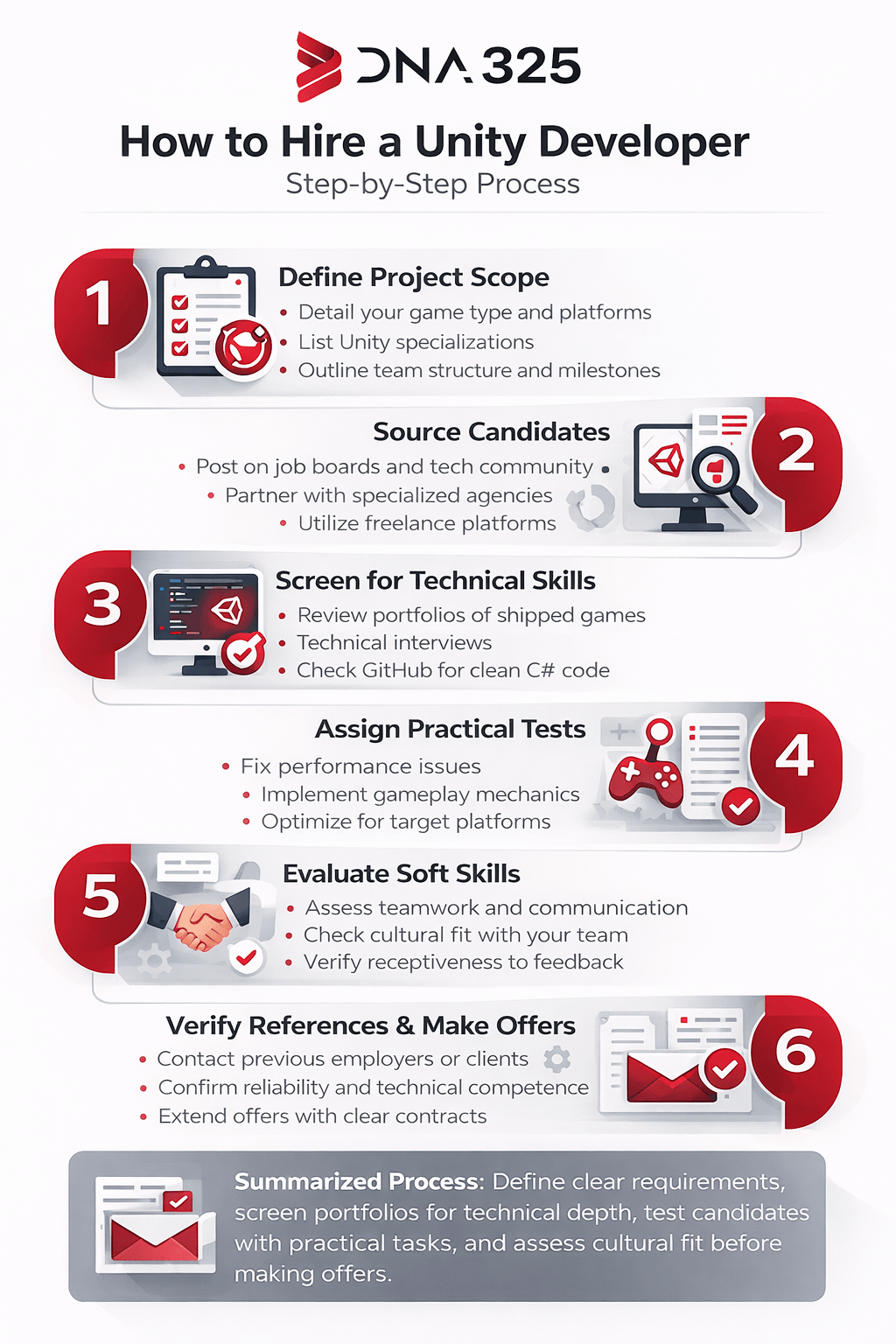
Step 1: Define your project scope
Write a detailed job description covering:
- Game genre or application type (mobile puzzle, 3D shooter, VR training)
- Target platforms (iOS, Android, Steam, Meta Quest)
- Required Unity specializations (multiplayer, AR, performance optimization)
- Team structure and collaboration model
- Project duration and milestones
Precise requirements attract qualified Unity game developers and reduce time waste.
Step 2: Source candidates strategically
Direct hiring: Post on IT-specific job boards, LinkedIn, and European tech communities. Search in Ukraine (Kyiv, Lviv), Poland (Warsaw, Kraków), Romania (Bucharest), Bulgaria (Sofia), and the Czech Republic (Prague).
Recruitment agencies: Partner with agencies specializing in European tech talent. They pre-vet candidates, handle the screening process, and match developers to your tech stack and timeline.
Freelance platforms: For smaller projects, explore Upwork or Arc. These platforms provide access to Unity freelancers with verified portfolios.
Step 3: Screen for technical competence
Review portfolios for shipped Unity projects. Look for:
- Links to playable demos on Steam, App Store, or Google Play
- GitHub repositories showing clean C# code
- Diversity of projects (mobile, console, VR)
- Problem-solving approaches in case studies
Conduct technical interviews asking about Unity’s rendering pipeline, optimization techniques, and debugging strategies.
Step 4: Assign practical assessments
Create tests matching your actual development scenarios:
- Fix performance issues in a provided Unity project
- Implement a specific gameplay mechanic (e.g., character controller, inventory system)
- Optimize a scene for mobile while maintaining visual quality
Hands-on evaluations reveal genuine capabilities better than theoretical discussions.
Step 5: Evaluate soft skills and cultural fit
Game development demands teamwork. Interview for:
- Communication clarity when explaining technical concepts
- Receptiveness to feedback
- Collaboration style with cross-functional teams
- Alignment with your company culture
Strong candidates articulate ideas clearly and adapt to different working styles.
Step 6: Verify references and make offers
Contact previous employers or clients. Ask about:
- Quality of delivered work
- Ability to meet deadlines
- How they handled technical challenges
- Team collaboration effectiveness
Once verified, extend offers with clear contracts covering IP ownership, remote work expectations, and deliverables.
Why remote recruitment works for Unity development
Short answer: Remote hiring gives you access to Europe’s entire Unity talent pool without geographical limits or local entity requirements.
Unity development adapts naturally to remote work. Developers need Unity Engine, a code editor (Visual Studio), version control (Git), and collaboration tools (Slack, Jira). These tools work seamlessly across distributed teams.
European Unity developers bring remote work experience. Many have worked with international clients and understand Agile workflows, asynchronous communication, and self-management.
Time zones support productivity. European developers overlap with US East Coast mornings and cover full EU business hours. This enables:
- Real-time code reviews during mutual working hours
- Daily standups at convenient times
- Faster iteration cycles with overnight builds
Remote recruitment also eliminates the costs of establishing local offices, navigating foreign labor laws, or managing on-site HR. You hire talent, not infrastructure.
Unity developer market trends in 2026
Short answer: Unity adoption continues growing, with increased demand for XR developers, multiplayer specialists, and AI integration experts.
Growing demand for XR development
Unity’s XR capabilities power leading VR titles like Beat Saber. Businesses need Unity developers to build immersive AR training applications, VR showrooms, and mixed-reality experiences.
Hire Unity developers with XR Interaction Toolkit experience, spatial audio implementation skills, and optimization for Meta Quest and Apple Vision Pro.
Multiplayer and live operations expertise
Mobile and PC games increasingly rely on real-time multiplayer features. Unity developers proficient in Photon, Mirror, or Unity Netcode are in high demand.
Live operations (post-launch updates, seasonal content, patch management) require developers with expertise in server architecture and content delivery networks.
AI integration in Unity projects
AI-driven NPCs, procedural content generation, and adaptive difficulty systems create immersive gameplay. Unity developers now integrate machine learning models, implement behavior trees, and optimize AI pathfinding.
Cross-platform optimization remains critical
Players expect smooth performance whether on iPhone 17, PlayStation 5, or Android devices. Unity’s “build once, deploy anywhere” approach only works with proper platform testing.
Hire Unity developers who profile performance across devices, implement dynamic quality settings, and use Unity’s Addressables for efficient asset loading.
Hiring Unity development teams vs. individual contributors
Short answer: Hire a Unity developer for specific features or bug fixes. Build dedicated teams for full game development cycles.
When to hire Unity developer (individual)
Best for:
- Adding specific features to existing projects
- Prototyping new game mechanics
- Fixing performance issues or bugs
- Short-term contracts (1–3 months)
- Supplementing your in-house team
Individual Unity developers work well when you have clear, defined tasks and internal leadership to guide technical decisions.
When to hire Unity developer teams
Best for:
- Full game development from concept to launch
- Large-scale projects requiring diverse skills (networking, art pipeline, UI/UX)
- Long-term development (6+ months)
- Projects needing coordinated effort across disciplines
Dedicated teams include Unity programmers, technical artists, UI developers, and QA specialists. This model works when you lack internal game development infrastructure.
Recruitment agencies can assemble pre-vetted teams, reducing your hiring burden while ensuring skill complementarity.
Partner with DNA325 for remote Unity developer recruitment
Finding skilled Unity developers in Europe’s competitive market takes time and expertise. DNA325 specializes in remote recruitment across Ukraine, Poland, Romania, Bulgaria, the Czech Republic, and other European countries. We connect US and EU businesses with pre-vetted Unity talent.
DNA325 handles the entire recruitment process: candidate sourcing, technical screening, skills assessment, and cultural fit evaluation. You receive matched Unity developers ready to join your remote team, without the complexity of local hiring or entity setup.
Contact DNA325 to discuss your Unity development needs and access Europe’s top remote talent.
Frequently asked questions
With recruitment agencies, 2–4 weeks for pre-vetted candidates. Direct hiring takes 6–12 weeks, including sourcing, interviewing, and negotiations. Agencies accelerate the process by maintaining networks of available Unity specialists.
Access to Europe’s 400,000+ developer talent pool without geographical limits. Lower operational costs (no office setup or local entity requirements). Time zone overlap with the US/EU. High English proficiency and cultural alignment with Western business practices.
No single “best” country. Each offers strengths. Ukraine offers deep gaming expertise and a large talent pool. Poland leads in business maturity and GDPR compliance. Romania balances quality with competitive rates. Bulgaria offers exceptional value. The Czech Republic excels in simulation and technical innovation. Choose based on your specific needs.
Request portfolios with shipped projects. Assign practical coding tests (build a mechanic, optimize performance, fix bugs). Check GitHub for code quality. Interview about Unity’s rendering pipeline, optimization strategies, and debugging approaches. Contact references from previous employers or clients.
Yes. Romanian, Polish, and Bulgarian developers rank highest for English proficiency in Eastern Europe. Ukrainian and Czech developers also demonstrate strong English skills. Most have experience working with international clients and are proficient in technical English for documentation and code comments.
Individual Unity developers join your team for specific tasks or features. Development agencies provide complete teams that handle the full project lifecycle: design, development, QA, and deployment. Agencies suit businesses without an internal game development infrastructure. Individual hires work when you need targeted expertise.
Absolutely. European Unity developers build multiplayer games using Photon, Mirror, and Unity Netcode. They understand client-server architecture, real-time synchronization, and latency compensation. Verify multiplayer experience by reviewing shipped titles and asking technical questions about networking challenges.
European time zones align well with US and European business hours. Schedule core collaboration hours overlapping your morning with their afternoon. Use asynchronous communication (Slack, Jira) for updates. European developers work independently and provide daily progress reports. Many adjust schedules for critical client meetings.
Work with recruitment agencies handling contracts, compliance, and payments. If hiring directly, use Employer of Record (EOR) services for payroll and tax compliance. EU countries like Poland, Romania, Bulgaria, and the Czech Republic provide strong IP protection and GDPR compliance. Ensure contracts specify IP ownership clearly.
Reputable agencies assess technical skills through coding tests, portfolio reviews, and technical interviews. They verify English proficiency, remote work experience, and soft skills. Agencies like DNA325 specialize in European tech talent and pre-screen candidates against your requirements, saving you time.