

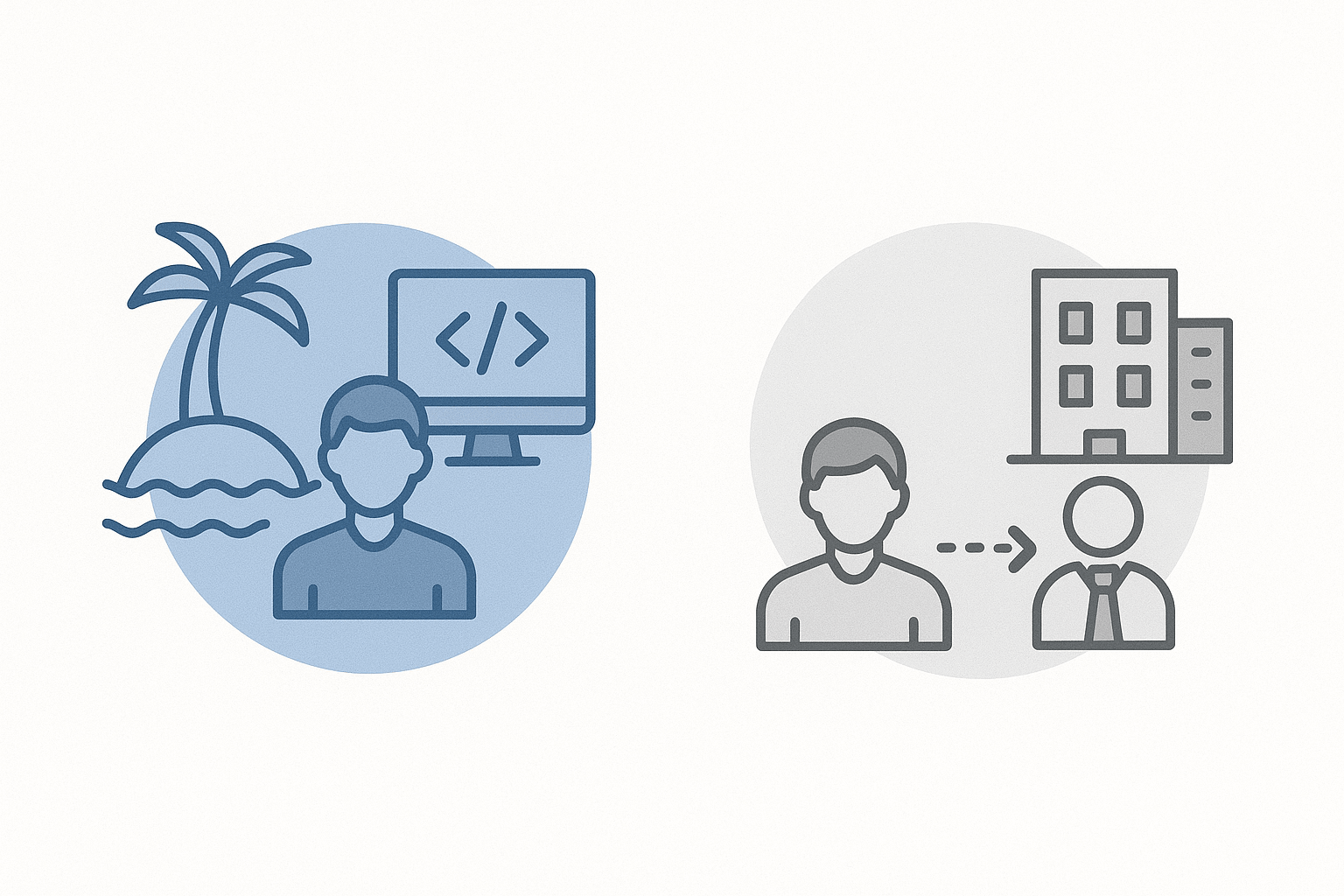
Many companies face a critical choice: Should we build our own offshore development team, or partner with an external vendor? Both offshore software development and development outsourcing solve talent shortages and accelerate the process. But they operate differently, and the wrong model can slow your progress or drain resources. Let’s break down both models to help you decide which aligns with your business stage, team structure, and growth goals. 👇
What is software development offshoring?
Software development offshoring is an approach where you establish and own your department in another country. It acts as an extension of your company. You build the team, set the processes, and manage day-to-day operations directly.
What is outsourcing?
Outsource development is when you hire an external company to handle operations. You don’t own the team, but you pay for their services. They work for you on a project basis or on a retainer, i.e., for ongoing availability and support.
What is the difference between offshoring and outsourcing?
| Factor | Offshore development | Outsource IT development |
| Ownership | You own the team. | The external company owns the team. |
| Control | Direct management of processes, hiring, and daily work. | Limited control. Vendor manages day-to-day. |
| Duration | Long-term commitment. | Project-based or flexible term. |
| Management overhead | Higher: You handle HR, onboarding, and performance reviews. | Lower: Vendor handles operations. |
| Flexibility | Lower: Paying salaries and office costs regardless of workload. | Higher: Scaling services up or down as needed. |
Advantages of offshore software development
Software development offshoring has these advantages:
- Ownership and complete control.
- Access to specialized talent.
- Long-term investment and loyalty.
- Round-the-clock coverage.
- Cost efficiency.
Ownership and full control
You set the team’s processes, management methodology, and project priorities. In addition, you hire the developers, train them in your tech stack, and directly influence quality and delivery speed. If performance isn’t meeting expectations, you address it immediately with your team, not through a vendor intermediary.
Access to specialized talent
Remote hiring expands your reach far beyond your geographic location. You’re not limited to local labor markets and have more flexibility to build a team with specific skills. It doesn’t matter whether that’s blockchain developers, machine learning engineers, or other niche experts.
Long-term investment and loyalty
Another benefit of offshoring is that your team becomes invested in your company’s success. They learn your codebase, understand your architecture, and contribute to long-term initiatives. When people feel connected to the mission, it also improves retention.
Round-the-clock coverage
With teams across time zones, development continues while your primary office sleeps. A bug identified in New York gets worked on by your European team before morning. This accelerates iteration cycles and time-to-market.
Cost efficiency
According to 2025 data, offshore software development can be 40–70% lower in cost than onshore ($20–$50/hour compared to $80–$150+).
Disadvantages of offshore development
The offshore development model comes with some pitfalls:
- Higher management overhead.
- Cultural and communication challenges.
- Upfront investment and risk.
- Compliance and security responsibility.
Higher management overhead
You handle recruitment, onboarding, team culture, performance reviews, and employee development. Additionally, you manage timezone differences and ensure consistent communication. This requires dedicated leadership attention.
Cultural and communication challenges
Different work styles, communication norms, and decision-making approaches can create friction. Time zone gaps require asynchronous communication, which slows some interactions. Language barriers, while usually manageable with fluent English speakers, still need clarity and patience.
Upfront investment and risk
You can’t establish an offshore team without resources: legal setup, talent recruitment, office infrastructure (or coordination with co-working spaces), and a learning curve before full productivity. This investment is sunk before the team delivers results.
Compliance and security responsibility
Offshoring involves responsibility for data protection, tax compliance, labor law adherence, and intellectual property safeguards. The need to navigate foreign legal systems adds complexity.
Advantages of development outsourcing
The benefits of dev outsourcing are as follows:
- Flexibility and scalability.
- Specialized expertise without long-term commitment.
- Lower operational burden.
- Fast time-to-delivery.
Flexibility and scalability
You pay only for work completed. Need 10 developers for a mobile app sprint? Hire them for three months, then scale back. No ongoing salary obligations or office overhead when the project ends.
Specialized expertise without long-term commitment
Outsourcing works well for one-off needs: a security audit, a legacy system migration, a specialized domain like financial compliance, or AI model training. You access expert knowledge without building and retaining that capability internally.
Lower operational burden
The outsourcing partner handles recruitment, onboarding, performance management, and infrastructure. Your team focuses on requirements and communication, not HR logistics.
Fast time-to-delivery
Mature outsourcing firms have established processes and bench strength. They spin up projects quickly because they manage resource allocation across multiple clients.
Disadvantages of outsource development
IT project outsourcing has the following drawbacks:
- Limited control over quality and process.
- Vendor prioritization and attention.
- Knowledge loss and vendor lock-in.
- Limited customization.
Limited control over quality and process
You can’t directly influence how the work gets done. If quality or timelines slip, your leverage is contractual, not immediate management intervention. In simple terms, you’re dependent on the vendor’s processes and team.
Vendor prioritization and attention
Outsourcing firms manage multiple clients simultaneously. Your project may not be their priority, especially if a larger client’s crisis emerges. Attention and quality vary based on their workload.
Knowledge loss and vendor lock-in
It’s the outsourcing vendor who holds the domain knowledge. If you switch vendors mid-project or after delivery, you lose continuity. Documentation may be incomplete or unavailable.
Limited customization
In outsourcing arrangements, the focus is usually on efficiency and profit, which sometimes means “acceptable quality” rather than excellence. Custom processes that benefit your specific workflow aren’t always a priority.
Which model should you choose between offshoring and outsourcing?
When to select software development offshoring
An offshore development team is your perfect fit if you need and want to:
- Have additional development capacity (6+ months minimum).
- Directly control team culture, processes, and hiring.
- Invest in management and communication infrastructure.
- Ensure round-the-clock development or timezone coverage.
- Retain the team in the long term and build institutional knowledge.
Example of offshoring: A US fintech startup needs to triple development capacity and meet product roadmap goals over the next 18 months. In this case, offshoring makes sense. They’ll own the team, shape their technical approach, and benefit from timezone-distributed work.
When to outsource IT development
You’d better outsource software projects if you:
- Require specialized expertise for a particular project or short-term work (under 6 months).
- Lack in-house capability in a specific domain and don’t plan to build it internally.
- Want minimal operational overhead.
- Prefer predictable, project-based costs.
- Need rapid deployment without recruitment and onboarding delays.
What is an example of outsourcing? A European e-commerce firm needs a 12-week blockchain integration for a loyalty program. They outsource to a specialized blockchain vendor. Once the integration launches, they maintain it in-house. No need to build a permanent blockchain team.
Hybrid approach: combining outsourcing and offshoring
Many mature companies do both. They maintain a core offshore software development team for ongoing processes, while outsourcing focused or time-bound projects to external partners.
European locations for the offshore development team
If you decide to choose offshoring vs outsourcing, where should you establish your team? Europe, for example, offers strong options, including Eastern, Southern, and Baltic countries. 👇
Eastern Europe
Poland, Romania, Bulgaria, the Czech Republic, and other countries in the region have:
- Mature tech ecosystems.
- Large developer pools.
- High English proficiency.
- Cultural alignment with Western markets.
Tax environments are stable, legal frameworks support international businesses, and timezone overlap with Western business hours is convenient (1–8, depending on region).
Southern Europe
Countries like Portugal, Spain, and Italy are emerging tech hubs. For instance, Portugal stands out with government incentives for startups and a steadily expanding developer talent pool. Portuguese business culture is generally aligned with Western norms. This provides a good fit for companies with headquarters on the continent and beyond, including the US.
Baltic region
Lithuania, Latvia, and Estonia have advanced tech ecosystems, high-quality developers, strong English skills, and progressive government policies supporting tech businesses. Estonia particularly excels in fintech, blockchain, and cybersecurity talent.
Key takeaway: Each location offers different advantages. Evaluate based on your needs: technical specialization, language requirements, timezone preferences, and growth plans. Before committing, research visa policies, legal structures for foreign companies, and talent availability in your domain.
How to build an offshore software development team successfully
To establish an offshore team, you should:
- Choose your offshore development center model.
- Hire for culture fit and technical skills.
- Create a straightforward onboarding and role definition.
- Establish communication rhythms.
- Give meaningful feedback.
- Invest in team connection. 👇
Choose your offshore development center model
There are two models: contractor ODC and customer ODC.
Contractor ODC model
This model is more suitable for small and medium-sized businesses. The ODC performs a wide variety of tasks (analytics, developing new software and updating existing products, support, UX and UI design, and even a fractional CMO), not only research and development. It’s staffed by a variety of specialists. The ODC completes projects according to specifications provided by the main office.
Customer ODC model
This model is more often used by enterprises. The client company that establishes an ODC takes care of analysis, design, and management tasks. This kind of ODC is less independent and has a narrower scope. It’s a team of software engineers, testers, and project managers focused on producing high-quality code, while other processes are maintained in the main office.
Hire for culture fit and technical skills
Recruit people who share your company’s values and communication style, not just technical expertise. Skills can be trained, while culture and communication style are harder to change. This is critical when managing remotely.
Create a straightforward onboarding and role definition
Spend extra time during the first 30–60 days clarifying expectations, processes, and communication norms. Provide documentation, training, and access to internal systems. Assign mentors from your primary office.
Establish communication rhythms
Define synchronous meeting times (daily standups, weekly syncs) and asynchronous workflows (Slack, documentation, code reviews). Simplify language in written communication, as even fluent English speakers appreciate clarity.
Give meaningful feedback
Remote teams need more detailed feedback than those working on-site. Provide specific, actionable guidance on work quality, speed, and collaboration. Recognize progress.
Invest in team connection
Occasionally, bring offshore team members to your primary office or conduct video team-building. Remote work can feel isolating, so intentional connection helps strengthen retention and culture.
How to implement dev outsourcing successfully
If you choose to outsource, take the following action:
- Vet the outsourcing partner.
- Define requirements and acceptance criteria clearly.
- Establish a governance structure.
- Document deliverables and processes.
- Plan for knowledge transfer. 👇
Vet the outsourcing partner
Review their portfolio, case studies, and client references. Assess their technical expertise in your specific domain. Confirm their security practices and certifications (ISO 27001, SOC 2, etc.).
Define requirements and acceptance criteria clearly
Ambiguity kills outsourcing projects. Write detailed specifications, acceptance criteria, and success metrics. Include a change management process for scope adjustments.
Establish a governance structure
Designate a single point of contact on your side. Define how decisions get made, how changes are approved, and who signs off on payments. Regular check-ins prevent misalignment.
Document deliverables and processes
Require clear documentation, commented code, and process walkthroughs. This prevents knowledge loss if you later transition to internal ownership.
Plan for knowledge transfer
Before the engagement ends, ensure your team understands what was built and how to maintain it. Schedule knowledge-transfer sessions and on-site time, if possible.
Getting started with offshoring or outsourcing
Choosing between offshoring and outsourcing depends on your timeline, budget, team structure, and strategic vision. Offshoring builds permanent capacity and control, whereas outsourcing solves immediate, focused needs.
The offshore software development market is projected to reach $283B by 2031, growing at 10.1% annually, while outsourcing is estimated to hit $897B by 2030, increasing at 9.7%. This underscores the strategic importance of both models across enterprises of all sizes.
Many companies benefit from both. Start by identifying your exact need: Is this a long-term capacity gap or a short-term project? Do you need permanent expertise or temporary help?
Once you’ve decided on your approach, focus on execution. Whether you’re building an offshore team or partnering with an outsourcing firm, clear communication, thorough vetting, and ongoing alignment are key to success.
Finding the right talent, whether for an offshore team or an outsourcing partnership, requires specialized expertise. For example, DNA325 is a recruitment agency with experience across Europe. We help businesses accelerate hiring timelines, ensure cultural fit, and grow remote teams.
Frequently asked questions about outsourcing/offshoring
Typically, 2–4 months from the decision to the first developer starting. This includes legal entity formation, recruitment, onboarding, and initial productivity ramp. Under ideal conditions, the team typically achieves 90% productivity by the fourth month.
European locations offer overlap with US hours (1–8 hours depending on region), which allows real-time collaboration for most interactions. Morning meetings on the US East Coast align with late afternoon in Poland or Romania.
Both require strong data protection agreements and security controls. Offshoring gives you direct control over security measures, while outsourcing relies on your vendor’s practices and certifications. Audit security carefully, regardless of which model you choose.
Absolutely. Many companies start with an outsourcing vendor for a short-term project, build domain expertise internally, then transition to owning a permanent team. This reduces upfront risk.
Evaluate both models. Outsourcing specialized expertise to a vendor is often more efficient than hiring and training in-house, especially for one-time needs. For ongoing capability, consider bringing expertise in-house after the initial project.
Require clear IP assignment clauses in contracts. Implement non-disclosure agreements, restricted access controls, and secure communication channels. For offshoring, you maintain direct control, while for outsourcing, you audit your vendor’s security infrastructure and compliance certifications.